

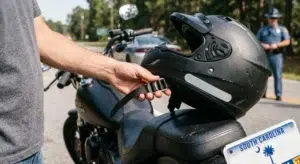
No, not if you are 21 or older. South Carolina law only requires riders and passengers under age 21 to wear a helmet while riding a motorcycle in SC. Anyone under 21 who operates or rides on a two-wheeled motorized vehicle must wear an approved protective helmet with a neck or chin strap and reflective material on both sides.
For adults 21 and older, wearing a helmet is a personal choice under state law. That does not mean helmets are unimportant. Federal safety research shows that helmets meeting federal standards significantly reduce the risk of death and brain injury. If you are hurt in a crash, helmet use may also come up during a motorcycle injury claim SC, even when the law did not require you to wear one. So it’s best to consult with a motorcycle accident lawyer at Shelly Leeke Law Firm as soon as possible.
What Does South Carolina Motorcycle Helmet Law Require?
SC motorcycle helmet laws are found in S.C. Code § 56-5-3660. Under the statute, it is unlawful for a person under the age of 21 to operate or ride upon a two-wheeled motorized vehicle unless that person wears a protective South Carolina Department of Public Safety approved helmets.
Two parts of that wording matter:
- It applies to operators and passengers. The law covers anyone under 21 who operates the motorcycle or rides on it. A 19-year-old passenger must wear a helmet just like a 19-year-old rider.
- It applies to two-wheeled motorized vehicles. The statute is not limited to large motorcycles; the key test is a two-wheeled motorized vehicle.
A closely related law, S.C. Code § 56-5-3670, also requires operators under 21 to wear eye protection or face shield of an approved type. Violating these equipment laws is a misdemeanor that can carry a fine.
Because the helmet requirement is set by state law, local governments cannot add their own. In 2008, Myrtle Beach passed an ordinance requiring all motorcyclists to wear helmets. In June 2010, the South Carolina Supreme Court held in Aakjer v. City of Myrtle Beach that state law preempted the ordinance because helmet rules need to be uniform statewide. The same age-based rule applies everywhere in South Carolina.
Do Riders Age 21 and Older Have to Wear a Motorcycle Helmet in SC?
No. Under § 56-5-3660, the helmet requirement applies only to people under 21. A rider or passenger who is 21 or older is not legally required to wear a helmet in South Carolina.
Here is how the rule breaks down:
| Person on the motorcycle | Helmet legally required? |
| Operator under 21 | Yes, an approved motorcycle helmet South Carolina (plus approved goggles or face shield) |
| Passenger under 21 | Yes, an approved helmet |
| Operator 21 or older | No |
| Passenger 21 or older | No |
Two points are worth noting. First, the law does not prevent adults from wearing a helmet. Many experienced riders choose to wear one every time they ride. Second, if an adult rider carries a passenger under 21, that passenger is still required to wear an approved helmet, regardless of the rider’s age.
What Kind of Motorcycle Helmet Is Required in South Carolina?
For riders and passengers under 21, not just any helmet satisfies the law. Under § 56-5-3660, the helmet must:
- Be a type approved by the South Carolina Department of Public Safety.
- Have either a neck strap or a chin strap.
- Be reflectorized on both sides.
The statute also authorizes the Department of Public Safety to adopt regulations setting helmet specifications and to maintain a list of approved helmets. Riders under 21 should check that their helmet meets these requirements before riding, rather than assuming a novelty or decorative helmet is enough.
For adults who choose to wear a helmet, the National Highway Traffic Safety Administration (NHTSA) recommends helmets that meet Federal Motor Vehicle Safety Standard 218, the federal performance standard for motorcycle helmets.
Why Wear a Helmet If South Carolina Law Does Not Require It?
It helps to separate two different questions: what South Carolina law requires, and what safety research shows.
What the law requires: For riders and passengers 21 and older, nothing. Wearing a helmet is a personal decision.
What safety research shows: According to NHTSA, wearing a helmet that meets federal safety standards is one of the most effective ways to reduce the chance of serious injury or death in a motorcycle crash. NHTSA reports that research indicates helmets reduce rider fatalities by 22% to 42% and brain injuries by 41% to 69%. NHTSA also notes that 39% of motorcyclists killed in crashes in 2021 were not wearing a helmet.
Motorcycles offer riders almost no structural protection in a crash. A helmet cannot prevent an accident caused by another driver, but it can lower the risk of catastrophic head and brain injuries when a crash happens.
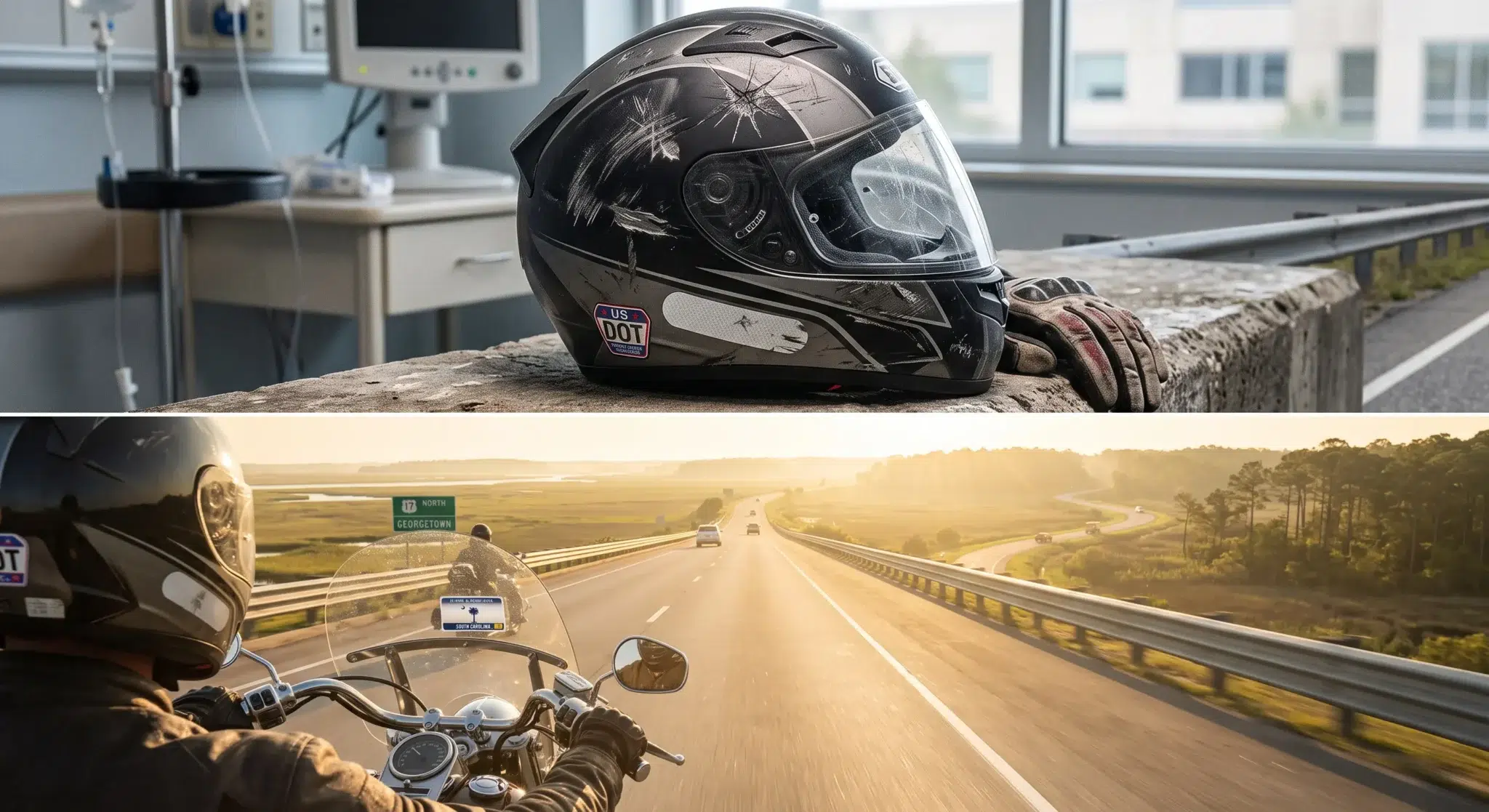
Can Riding Without a Helmet Affect an SC Motorcycle Accident Claim?
It can come up, but not wearing a helmet does not automatically eliminate a motorcycle injury claim in South Carolina, and it does not mean the rider caused the crash. A driver who turns left in front of a motorcycle or runs a red light is responsible for that conduct whether or not the rider wore a helmet.
South Carolina follows a modified comparative negligence rule under Nelson v. Concrete Supply Co. (1991). This means you can recover compensation as long as you are 50% or less at fault for the crash, though your payout is reduced by your percentage of blame. If you are found more than 50% responsible, you are completely barred from receiving compensation. Insurance companies often point to a rider’s decision not to wear a helmet to argue they share fault for their injuries and reduce or deny their claim.
Whether that argument has any weight depends on the facts, including:
- The rider’s age. A rider 21 or older had no legal duty to wear a helmet. A rider or passenger under 21 was required to wear one, which may raise different legal questions.
- Whether the rider was wearing a helmet, and whether it met the applicable requirements.
- The type of injury. Helmet use has little obvious connection to a broken leg or road rash. It is more likely to be raised with head or traumatic brain injuries.
- Medical evidence and causation. Any argument about helmet use generally depends on whether the evidence connects helmet nonuse to a specific injury.
Because these issues are fact-specific, how a helmet question affects a particular claim should be evaluated by a lawyer who can review the evidence.
What Should I Do After a Motorcycle Accident in South Carolina?
Taking the right steps immediately after a motorcycle crash is critical to protect your health, gather key evidence, and safeguard your legal claim. If you are involved in an accident, follow these essential steps:
- Get medical care right away, especially for any head, neck, or back pain.
- Call the police so the crash is documented, and request a copy of the accident report.
- Photograph the scene, vehicles, road conditions, and your injuries.
- Get names and contact information for witnesses.
- Keep your helmet, riding gear, and motorcycle in their post-crash condition. Damage to a helmet can help show how the impact happened.
- Save all medical records, bills, and proof of missed work.
- Avoid discussing helmet use or fault with the other driver’s insurance company before getting legal advice.
Download our South Carolina accident victims guidebook to learn more about protecting your rights after a crash.
Consult With a South Carolina Motorcycle Accident Lawyer Today
Helmet laws answer if a rider should wear a helmet while riding a motorcycle in SC. They do not decide who caused a crash. If you were injured in a South Carolina motorcycle accident, with or without a helmet, contact Shelly Leeke Law Firm at (843) 604-3273 for a free consultation with a South Carolina motorcycle accident lawyer about your circumstances.