
Traumatic brain injuries are common and a major cause of death and disability in the United States. If you are struggling with the aftermath of a head wound, a Charleston traumatic brain injury lawyer at the Shelly Leeke Law Firm can evaluate your legal options during a free consultation.
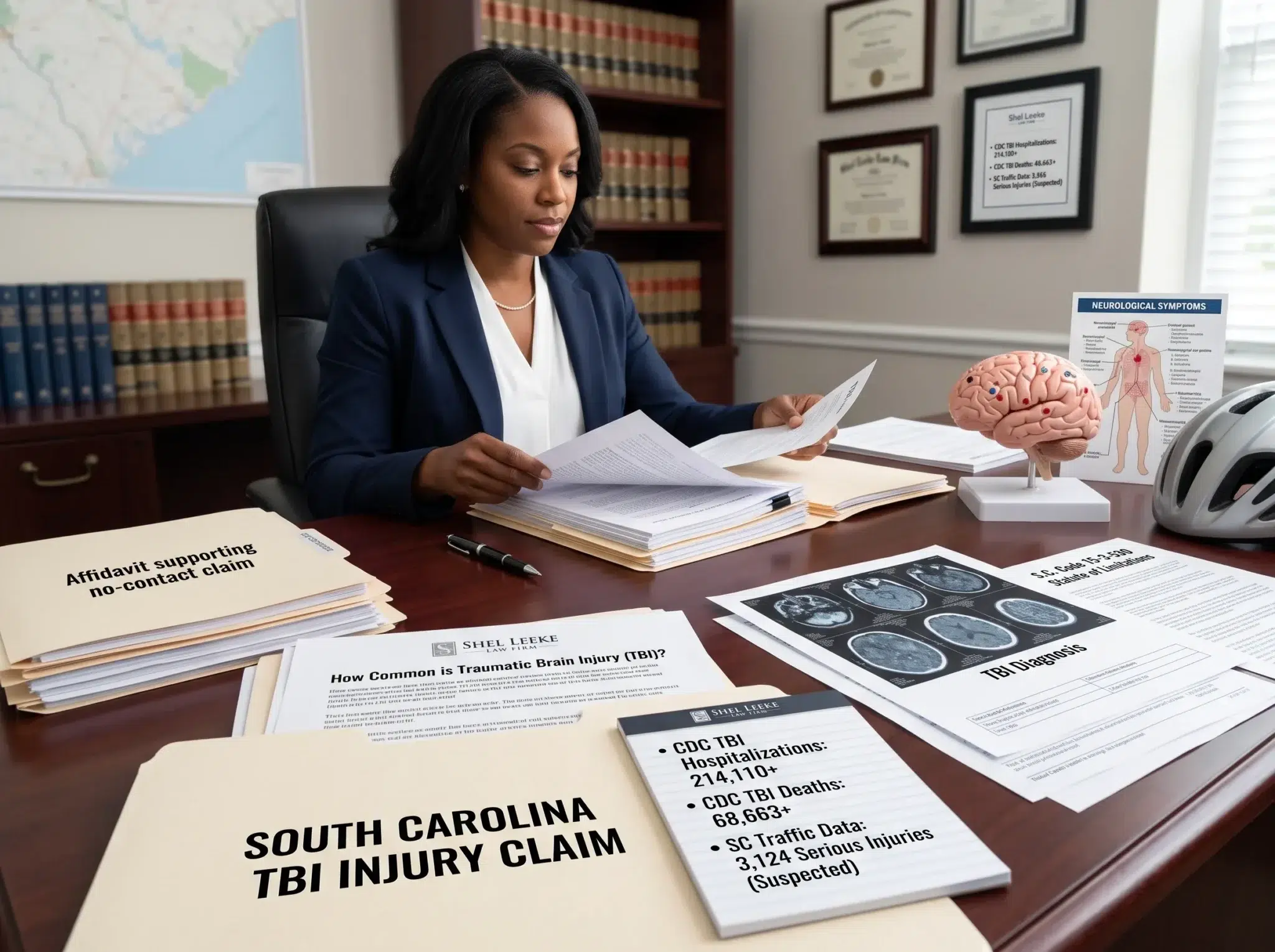
So, how common is traumatic brain injury? According to the Centers for Disease Control and Prevention (CDC), there were approximately 214,110 TBI related hospitalizations in 2020 and 68,663 TBI related deaths in 2023. Those numbers only capture the most serious cases. The CDC notes that they do not include the many TBIs treated only in emergency departments, primary care, or urgent care, or those that go untreated.
So there is no single number that answers how common traumatic brain injury is. The true total is higher than hospitalization and death counts suggest, and most TBIs each year are mild TBIs or concussions.
South Carolina Severe Traffic Injury Data
Traumatic brain injuries are frequently the result of severe traffic collisions. The South Carolina Department of Public Safety closely tracks the severity of injuries sustained on state roadways, revealing just how frequently catastrophic harm occurs on our local interstates and intersections:
South Carolina Statewide Metric |
Annual Crash Data |
| Total Suspected Serious Injuries | 3,124 Persons |
| Total Injury Producing Collisions | 38,102 Crashes |
| Total Fatalities | 1,036 Persons |
How Many People Experience Traumatic Brain Injuries?
CDC data tracks different levels of care separately:
- Hospitalizations: about 214,110 in 2020, or more than 586 per day.
- Deaths: 68,663 in 2023, or about 190 per day.
- Emergency, outpatient, and untreated injuries: not included in the figures above.
These figures come from different years and different data systems, so they should not be added together or treated as a yearly total. Hospitalization data is not the same as total TBI incidence. Many people with a concussion are treated and released, see their regular doctor, or never seek care.
The CDC also reports that adults 75 and older had the highest numbers and rates of TBI related hospitalizations and deaths. Males were nearly twice as likely as females to be hospitalized and three times as likely to die from a TBI. Locally, a Columbia severe concussion attorney sees these exact statewide demographic trends mirror our local hospital admissions.
What Are the Most Common Causes of TBI?
A TBI is an injury that affects how the brain works. It can be caused by a bump, blow, or jolt to the head, a hit to the body that makes the head and brain move quickly, or a penetrating injury. According to the CDC’s TBI facts:
- People most commonly get TBIs from falls, firearm related injuries, motor vehicle crashes, or assaults.
- Falls lead to nearly half of TBI related hospitalizations.
- Motor vehicle crashes and assaults are other common causes. In major metro areas, a North Charleston car accident TBI lawyer frequently handles catastrophic injury claims resulting from high speed interstate collisions.
How Common Are Mild TBIs and Concussions?
The CDC states that most TBIs each year are mild TBIs or concussions. A concussion is a form of mild TBI.
Mild is a medical label. It usually means the injury is not life threatening, not that it is harmless. The CDC stresses that the effects of a mild TBI or concussion can be serious. Anyone who may have one should be seen by a healthcare provider.
What Are the Symptoms of a Traumatic Brain Injury?
According to the CDC, symptoms of mild TBI and concussion differ from person to person. They may affect how someone feels, thinks, acts, or sleeps:
- Physical: headaches, dizziness, balance problems, nausea, vision problems, sensitivity to light or noise.
- Thinking: trouble concentrating, memory problems, feeling foggy or slowed down.
- Emotional: irritability, anxiety, sadness.
- Sleep: sleeping more or less than usual, trouble falling asleep.
Some symptoms appear right away, while others may not show up for hours or days. Call 911 or go to an emergency department if someone has a headache that gets worse and does not go away, repeated vomiting, seizures, slurred speech, unusual behavior, increasing confusion, one pupil larger than the other, or cannot be woken up. For more, see our article on signs of a traumatic brain injury.
Can a TBI Happen Without a Person Losing Consciousness?
Yes. CDC concussion materials note that most concussions occur without loss of consciousness. A person can walk away from a crash alert and still have a mild TBI. That does not mean every head impact causes a TBI. Only a healthcare provider can evaluate a suspected injury.
Can a TBI Cause Long Term Problems?
It depends on the injury. The CDC explains that many people with a mild TBI or concussion feel better within a couple of weeks or months. People with a moderate or severe TBI may have long term or lifelong effects.
Depending on severity and individual circumstances, effects may involve:
- Memory
- Concentration
- Balance
- Communication, and
- Emotional health, along with
- The ability to work and manage daily life.
Not every TBI causes permanent problems. Repeated concussions may lead to a longer recovery.
Are Traumatic Brain Injuries Common After Car Accidents?
Motor vehicle crashes are one of the recognized common causes of TBI. In a car accident, the brain can be injured by a direct hit to the head or by the sudden, violent movement of the head from collision forces, even without visible head wounds.
Not every car accident in South Carolina causes a TBI. The CDC also recommends that healthcare providers check older adults for TBI after a car crash.
Can Motorcycle, Truck, Pedestrian, or Other Accidents Cause TBI?
Yes. TBIs can occur in motorcycle, truck, pedestrian, and bicycle crashes, where riders and pedestrians have little protection.
They can also result from falls on unsafe property. A Greenville head injury law firm routinely sees traumatic brain injuries arise when commercial trucking companies violate federal safety regulations and strike unprotected commuters.
Why Can a TBI Be Difficult to Recognize?
The CDC notes that TBI symptoms can be hard to sort out because they resemble other health problems. An injured person may not recognize or admit having problems, and symptoms may be overlooked by the person, their family, or even their healthcare provider.
TBIs may be missed in older adults because symptoms can overlap with conditions such as dementia. The CDC also notes that a CT scan is not needed to identify a mild TBI, but may sometimes be used when bleeding on the brain is a concern.
What Should I Do If I Think I Have a TBI After an Accident?
Medical care comes first:
- Get evaluated by a healthcare provider promptly.
- Follow your provider’s instructions and go to follow up appointments.
- Write down your symptoms and how they change.
- Keep your medical records and bills.
Can a Traumatic Brain Injury Lead to a Personal Injury Claim in South Carolina?
It may. If a TBI resulted from another party’s negligence, such as in a car, truck, motorcycle, or pedestrian crash, or an incident on unsafe property, the injured person may have a claim. Having a diagnosis does not by itself prove that someone else was legally responsible. Whether a claim is viable depends on
- the facts
- the evidence
- causation
- damages, and
- South Carolina law.
Depending on the circumstances, potential losses may include medical and rehabilitation expenses, lost income, reduced earning capacity, and pain and suffering.
To avoid paying these damages, insurance companies will often invoke the South Carolina comparative negligence 51 percent rule to claim you were responsible for the accident.
Furthermore, there are specific S.C. Code 15-3-530 statute of limitations deadlines that strictly limit how long you have to file a claim. If you suffered a TBI due to medical malpractice during an emergency room visit, the South Carolina damages caps 2026 adjustments limit non economic financial recovery to 596,001 dollars per individual provider.
What Evidence Can Help Document a TBI After an Accident?
Helpful evidence may include:
- Emergency room records, diagnostic records, and provider notes.
- Rehabilitation records.
- A record of your symptoms over time.
- Work records.
- Statements from family members about changes they have noticed.
- Accident reports and photographs.
Documenting how the injury affects daily life can matter as much as the diagnosis itself. Accurate records are always more valuable than exaggerated ones.
When Should I Talk to a South Carolina TBI Lawyer?
A consultation may help if someone else may have caused the accident, if your treatment is ongoing or the long term effects are unclear, if the injury affects your work or daily life, or if an insurer disputes your claim.
A South Carolina traumatic brain injury lawyer can review your circumstances. If a formal lawsuit becomes necessary to force the insurance company to act fairly, your attorney will file it at the proper local venue, such as the Ninth Judicial Circuit Charleston County.
Talk to Shelly Leeke Law Firm About a South Carolina TBI Claim
If you or a loved one suffered a TBI after a South Carolina accident, contact Shelly Leeke Law Firm at (843) 604-3273 for a free consultation. To speak with a Myrtle Beach motorcycle head injury attorney or another local representative, reach out to our team today.