

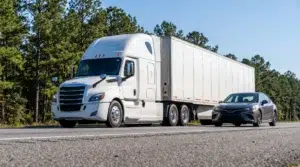
A tractor trailer is a large commercial truck made up of a tractor (the cab and engine) pulling one or more trailers. If you are wondering how large is a tractor trailer, federal law generally caps its gross weight at 80,000 pounds when traveling fully loaded on the Interstate system. Many rigs weigh less, depending on what they carry.
Federal law requires states to allow trucks up to 102 inches wide, and trailers of at least 48 feet on the national truck network. Many trailers are longer, so the full rig is much longer than a car.
At the legal maximum, a loaded tractor trailer can weigh roughly 18 times as much as the average new passenger vehicle. That size difference is one reason crashes involving these trucks can be so serious. If you have been in a tractor trailer crash, contact our South Carolina truck accident lawyers at Shelly Leeke Law Firm today.
How Much Does a Tractor Trailer Weigh?
There is no single weight for every tractor trailer. It helps to separate three different numbers:
- Empty weight: what the tractor and trailer weigh without cargo. This varies by equipment.
- Loaded weight: the empty weight plus whatever the truck is carrying on a given trip.
- Legal maximum: the most a truck may weigh without a special permit.
According to the U.S. Department of Transportation, federal law sets these Interstate limits:
- 80,000 pounds gross vehicle weight, provided the truck also complies with the federal bridge formula, which limits weight based on the number and spacing of axles.
- 20,000 pounds on a single axle.
- 34,000 pounds on a tandem axle.
So when people say a tractor trailer weighs “up to 80,000 pounds,” they are describing the legal ceiling, not what every truck weighs.
How Long, Wide, and Tall Is a Tractor Trailer?
If you are asking how large is a tractor trailer in terms of length, width, and height, the answer depends on the equipment, but the legal framework looks like this:
| Dimension | What the rules say |
| Width | Federal rules allow commercial trucks up to 102 inches (8.5 feet) wide on the national truck network, not counting mirrors and certain safety devices. |
| Trailer length | Federal law requires states to allow semitrailers of at least 48 feet on the national network. States may allow longer trailers. |
| Overall length | For a standard tractor-semitrailer on the national network, states may not set an overall length limit, so total length depends on the tractor and trailer used. |
| Height | There is no federal height limit. Height limits are set by the states. |
Because states set height limits, and some length rules vary by state and route, the exact size of a legal truck can differ from one road to another. The Federal Highway Administration explains these federal size rules in more detail.
How Large is a Tractor Trailer Compared to a Passenger Car?
When comparing tractor trailer weight vs passenger car, the difference is large. According to the EPA’s 2025 Automotive Trends Report, the average new light-duty vehicle in model year 2024 weighed about 4,354 pounds. That figure covers cars, SUVs, pickups, and vans, and EPA’s measurement adds 300 pounds to each vehicle’s empty weight.
By comparison, a tractor trailer at the 80,000-pound legal limit weighs roughly 18 times as much. Even an empty rig is typically several times heavier than a passenger vehicle. That is why the old rule of thumb that the average car weighs 5,000 pounds overstates it.
What Are the Weight and Size Limits for Trucks in South Carolina?
South Carolina truck size and weight limits are found in S.C. Code §§ 56-5-4010 through 56-5-4230. On the Interstate, trucks must follow the federal weight limits described above.
When a vehicle or load exceeds the legal limits, the South Carolina Department of Transportation (SCDOT) may issue an oversize or overweight load permit SC. SCDOT’s permit guidelines explain that permits are generally meant for “non-divisible” loads, meaning a single item that cannot readily be broken down to meet legal limits. SCDOT may also set conditions on routes, travel times, and insurance.
What Is an Oversize or Overweight Load?
An oversize load is too wide, tall, or long to meet legal limits. An overweight load is too heavy. Under SCDOT’s guidelines, examples include heavy machinery or a manufactured home.
For wide loads, SCDOT requires:
- “Oversize Load” or “Wide Load” signs and red flags on loads 12 feet wide or wider.
- Escort vehicles as width increases.
- Both civilian and police escorts for loads over 16 feet wide.
Why Does the Size of a Tractor Trailer Matter in a Crash?
The Federal Motor Carrier Safety Administration (FMCSA) points to several operating limitations of large trucks:
- Longer Commercial Truck Stopping Distances – FMCSA says a fully loaded truck traveling at highway speed in good conditions needs almost two football fields to stop, and more with heavy loads or wet roads.
- Large Truck Blind Spots – Large trucks have “No-Zones” on all four sides. FMCSA’s rule of thumb: if you can’t see the truck driver in the side mirror, the driver may not see you.
- Wide Turns – Trucks may swing left before turning right.
- Truck Underride Collision – Because trucks ride high off the ground, a smaller vehicle can slide under a truck in a rear-end collision.
A truck’s weight and height can also contribute to rollover and jackknife crashes. Size alone does not mean anyone was at fault. It means the consequences of a mistake can be more severe.
How Common Are Serious Crashes Involving Large Trucks?
According to NHTSA’s 2023 large-truck fact sheet:
- 5,472 people were killed nationwide in traffic crashes involving large trucks.
- An estimated 153,452 people were injured.
- 70% of those killed were occupants of other vehicles, not the truck.
- In South Carolina, 122 people died in crashes involving large trucks.
NHTSA’s “large truck” category includes any truck over 10,000 pounds, not just tractor trailers.
What Rules Do Trucking Companies and Drivers Have to Follow?
Interstate trucking is regulated by FMCSA. Its rules cover:
- Hours of service, which limit how long drivers may drive and work.
- Driver qualifications and commercial licensing.
- Drug and alcohol testing.
- Vehicle inspection and maintenance.
These rules set safety standards. Whether any rule was followed or broken in a particular crash depends on the facts.
Can a Truck Crash Lead to an Injury Claim in South Carolina?
It can. If another party’s negligence contributed to a crash, an injured person may have legal options. Depending on the facts, responsibility may involve the truck driver, the trucking company, a cargo loader, a maintenance provider, or others. Whether someone has a claim depends on the evidence, fault, the injuries and losses involved, and other circumstances.
Timing matters. Many South Carolina truck injury claims must be filed within three years under S.C. Code § 15-3-530, though government-involved crashes face shorter Tort Claims Act deadlines. Fault matters too. Under South Carolina modified comparative negligence rule (Nelson v. Concrete Supply Co.), you can recover damages as long as you are 50% or less at fault, with your payout reduced by your percentage of blame. If you are more than 50% responsible, you are barred from receiving compensation.
Note: Because deadlines vary and exceptions exist, consult a lawyer promptly to evaluate your claim.

What Evidence Can Matter After a Tractor Trailer Crash?
Medical care comes first. After that, helpful tractor trailer crash evidence may include:
- The police report.
- Photographs of the scene and vehicles, taken only when it is safe.
- Medical records.
- Witness contact information.
- The trucking company’s name and the truck’s DOT number.
Some important records, such as driver logs, inspection and maintenance records, and electronic data from the truck, are typically held by the carrier and may be time-sensitive. A lawyer can explain the options for requesting that they be preserved. You can find more on this topic in our truck accident articles.
Discuss Your Case With an Experienced Truck Accident Lawyer
Understanding how large is a tractor trailer makes it clear why crashes involving commercial trucks often result in severe, life-altering injuries. Due to their massive weight, size, and stopping distances, truck accidents require immediate investigation to preserve key evidence like driver logs and black box data.
If you or a loved one was injured in a crash with a commercial rig, a South Carolina truck accident lawyer at Shelly Leeke Law Firm can review what happened, explain your legal options, and help protect your rights. Contact us today at (843) 604-3273 for a free, no-obligation consultation.