


In many situations, yes, but it depends on the type of coverage involved and the terms of your specific policy. If you are dealing with a complex liability dispute where you let a friend borrow my car, contact the Shelly Leeke Law Firm to speak with a Charleston car accident lawyer before speaking to an insurance adjuster.
Under South Carolina law, the insured under an auto liability policy includes anyone who uses the covered vehicle with the named insured’s consent, whether express or implied. So if your friend was driving with permission and caused a crash that injured someone or damaged their property, your liability coverage generally applies, up to your policy limits.
Damage to your own car is a different question. That depends on whether you carry collision coverage, which South Carolina does not require. Some policies also exclude specific named drivers.
If another driver caused the crash, that driver’s insurance is typically the main source of payment. For your exact coverage, check your policy or ask your insurer. A South Carolina car accident lawyer can help if a dispute or injury claim arises.
Does SC Insurance Follow the Car or Driver If a Friend Borrows It?
For liability coverage, it largely follows the car. S.C. Code 38-77-30 defines insured to include:
- The named insured and household relatives.
- Any person who uses, with the consent, expressed or implied, of the named insured, the motor vehicle to which the policy applies.
- Guests in the vehicle.
This specific S.C. Code 38-77-30 permissive use definition is crucial to your claim. This is often called permissive use. If you are asking, “Does my insurance cover my friend driving my car?”, the liability part of your policy generally does when your friend has permission.
That rule is about liability, meaning paying others for injuries or damage your friend causes. It does not decide whether your own car damage is covered. That depends on other parts of your policy, covered below.
What Does “Permission” Actually Mean?
The statute recognizes both express and implied consent:
- Express consent. You said yes, for example, “You can take my car to work.”
- Implied consent. Permission shown by the circumstances, such as a pattern of letting the person use the car or leaving the keys available for that purpose.
If you are facing an aggressive adjuster, a Mount Pleasant permissive driver attorney can help establish these facts. Disputes can arise over whether permission existed, or whether your friend went beyond it, such as driving somewhere or for a purpose you did not agree to. Those are fact-specific questions an insurer may investigate. Be accurate when you describe what you allowed.
Will My Policy Pay for Damage to My Own Car?
Only if your policy includes the right coverage. South Carolina requires liability coverage and uninsured motorist coverage with minimum limits of $25,000 per person and $50,000 per accident for bodily injury, and $25,000 for property damage, according to the South Carolina Department of Insurance. Because South Carolina Department of Insurance regulations dictate these baselines, collision coverage, which pays to repair your own vehicle after a crash, is not one of those requirements.
So:
- If you carry collision coverage, it may pay for your car damage, subject to your deductible and policy terms, regardless of who was driving. A North Charleston collision coverage attorney can ensure your carrier honors this clause.
- If you carry only the required liability coverage, damage to your own car may not be covered by your policy. Your options may then depend on whether another driver was at fault.
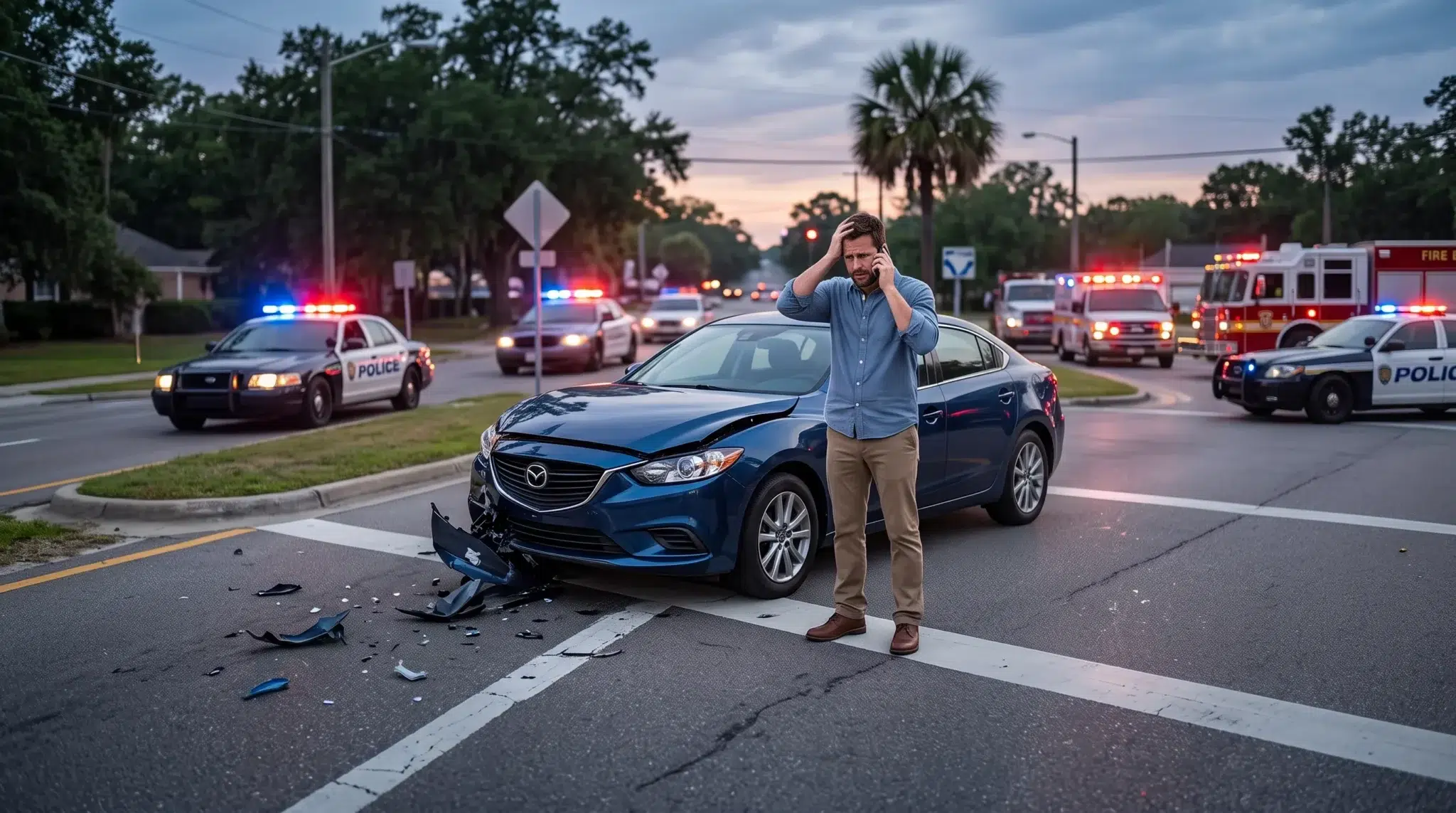
What If My Friend Caused the Accident?
If your friend was at fault and had permission, your liability coverage may pay the other people’s injury and property damage claims, up to your limits. If the damages exceed your limits, other coverage may come into play, such as your friend’s own policy if they have one. Because the claim is paid under your policy, it may appear in your claims history. See our FAQ on whether your premiums go up after a claim.
What If Someone Else Caused the Accident?
If another driver caused the crash, that driver’s liability insurance is typically the main source of payment. That covers your friend’s injuries and, often, the damage to your car. South Carolina follows modified comparative negligence (Nelson v Concrete Supply Co South Carolina, 1991).
A person may recover only if their own fault is not greater than the other party’s, and any recovery is reduced by their share of fault. Defense carriers routinely use the South Carolina comparative negligence 51 percent rule to argue your friend was partially to blame to avoid paying. If the other driver was uninsured, uninsured motorist coverage may matter.
Are There Situations Where My Policy Might Not Cover My Friend?
Yes. Examples include:
- Excluded drivers. Under S.C. Code 38-77-340, an insurer and named insured can agree in a written endorsement that liability coverage will not apply while a specifically named person is driving. That applies even if the person has permission.
- Scope of permission. If your friend used the car in a way you did not allow, the insurer may dispute coverage.
- Other policy terms. Policies can contain other exclusions or conditions, and these vary by insurer.
Because terms differ, read your declarations page and policy, or ask your insurer directly how your policy treats a permissive driver. If they act in bad faith, a Summerville auto insurance dispute lawyer can intervene.
Does My Friend’s Own Insurance Matter?
It can. Your policy is generally the first place to look for liability coverage because it covers your car. Your friend’s own auto policy, on another vehicle, may provide additional coverage in some situations, depending on its terms. Whether and in what order the policies apply is a policy-by-policy question. Neither insurer’s answer should be assumed.
What Should I Do After the Accident?
Here’s all that you need to do after an accident:
- Make sure anyone hurt gets medical care.
- Report the accident to your insurer promptly.
- Tell your insurer accurately who was driving and what permission you gave.
- Get your friend’s insurance information.
- Keep the police report number, photos, and all correspondence.
- Check your policy for collision coverage and any excluded drivers.
- Talk to a lawyer if coverage is denied or someone was seriously injured.
How Can a South Carolina Car Accident Lawyer Help?
A South Carolina car accident lawyer can:
- Help sort out whose insurance applies.
- Respond to disputes over permission or exclusions.
- Help an injured person pursue a claim against the right policy.
No lawyer can guarantee that a particular coverage will apply or a particular outcome. If litigation is required to enforce your policy terms, your lawyer will file the action at the Ninth Judicial Circuit Charleston County Court of Common Pleas.
Talk to Shelly Leeke Law Firm About Your Accident
If a borrowed car was involved in a crash and someone was hurt, request a free consultation with Shelly Leeke Law Firm or call (843) 604-3273. Have a Charleston borrowed vehicle accident lawyer at Shelly Leeke Law Firm Charleston review your case today.