


In most rear-end collisions in South Carolina, the driver who hit you from behind is generally found at fault. That is not because of an automatic legal rule. It is because South Carolina law requires drivers not to follow “more closely than is reasonable and prudent” and to use due care. A driver who runs into the back of another car has usually fallen short of that duty.
So, is the other driver automatically at fault for rear-ending me? Usually they are responsible, but not automatically. The facts still matter. For example, broken brake lights or an unexpected stop in traffic could become relevant, and South Carolina’s comparative fault rules may allow shared fault. You can still recover if your share of fault is not greater than the other driver’s.
Rear-end crashes also often cause neck and back injuries that are not obvious right away. A South Carolina car accident lawyer at Shelly Leeke Law Firm can help evaluate the facts of your crash.
Is the Driver Automatically at Fault for Rear-Ending Me in SC?
Two things work together:
- The following-distance statute: S.C. Code § 56-5-1930(A) provides that a driver “shall not follow another vehicle more closely than is reasonable and prudent, having due regard for the speed of such vehicles and the traffic upon and the condition of the highway.”
- The general duty of care: Every driver must keep a proper lookout, control their speed, and be able to stop safely for traffic ahead.
When a car strikes another from behind, the most common explanations are following too closely, distraction, or speed. Each of these points toward the rear driver. That is why rear drivers are usually found at fault. A police report noting that the rear driver was cited for following too closely can also be useful evidence, although a citation does not decide the civil claim on its own.
This is a strong practical inference, not a formal “automatic fault” rule. South Carolina civil jury instructions reflect this principle: a leading vehicle has no absolute legal position superior to that of a following vehicle, and each driver must exercise due care under the circumstances (SC Requests to Charge Civil § 28-23).
What Circumstances Could Affect Who Is at Fault?
The following are examples, not a complete list, of front-driver conduct that could become part of the fault analysis:
- Brake lights or taillights that were not working, especially at night.
- A sudden, unnecessary stop or an abrupt lane change directly in front of another car.
- Stopping in a travel lane without warning, such as with a disabled vehicle and no hazard lights, when moving off the road was possible.
- Reversing into the car behind.
- Chain-reaction crashes, where a car is pushed into the one ahead, which can spread responsibility among several drivers.
Even when one of these applies, the rear driver usually still has responsibility. These facts may lead to shared fault rather than no fault. Each case is decided on its own facts.
What If I Was Partly at Fault?
South Carolina follows modified comparative negligence, adopted by the South Carolina Supreme Court in Nelson v. Concrete Supply Co. (1991). Under that rule:
- You may recover damages as long as your share of fault is not greater than the other driver’s. In practice, that means 50% or less.
- Any recovery is reduced by your percentage of fault.
- If you are found more than 50% at fault, you cannot recover.
For example, if you are found 20% at fault because a brake light was out, your damages would be reduced by 20%. This rule comes from South Carolina case law, not a single statute.
What Kinds of Injuries Are Common in Rear-End Collisions?
A rear impact can snap the head and neck forward and back. Common results include:
- Whiplash-type neck strain.
- Back injuries.
- Concussions.
- Shoulder injuries.
These injuries do not always cause strong symptoms right away. Soreness and stiffness can build over the following days.
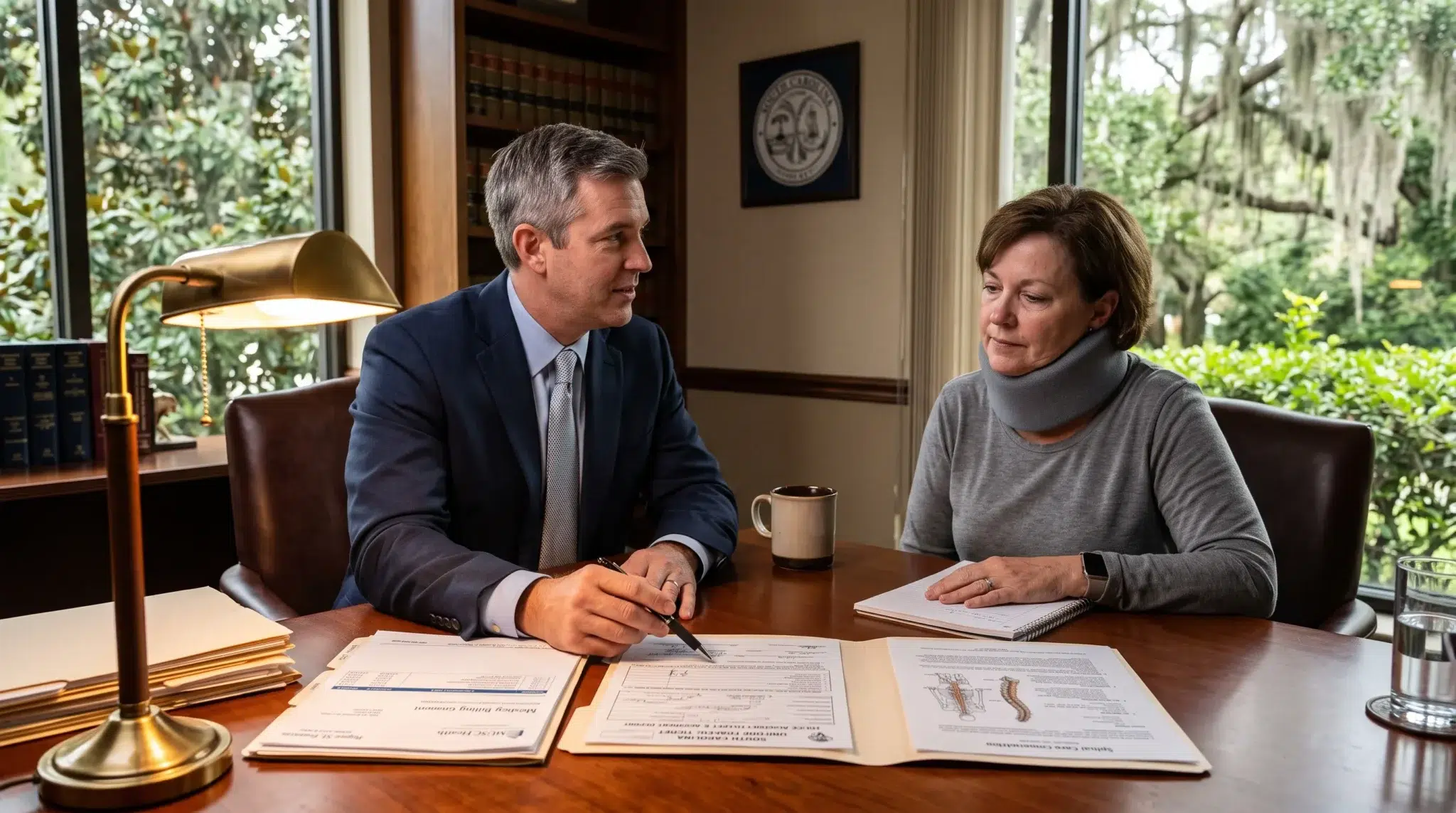
The amount of damage to the cars does not always match the injuries. A car with modern bumpers can show little visible damage while the people inside are hurt. Insurers sometimes question injury claims when the vehicle damage looks minor. Medical records made promptly after the crash can be important in addressing that.
What Damages May Be Available After a Rear-End Accident?
Depending on the facts, a person hurt in a rear-end collision may be able to seek:
- Property damage, including repair or replacement of the vehicle.
- Medical expenses, past and future, including therapy for soft-tissue injuries.
- Lost income, including time missed from work.
- Pain and suffering, meaning the physical pain and the effect on daily life.
What applies and how much may be recoverable depends on the injuries, the evidence, fault, and the insurance available. For help evaluating a specific offer, see our FAQ on how to tell if a settlement offer is fair.
What Should I Do After a SC Rear-End Accident?
Here are the steps you should follow after a South Carolina rear-end collision:
- Get a medical evaluation, even if you feel fine.
- Call the police and get the report number.
- Photograph both vehicles, the scene, and any visible damage, including minor damage.
- Exchange contact and insurance information.
- Get witnesses’ names and phone numbers.
- Avoid debating fault at the scene.
- Keep your medical records and repair estimates.
- Talk to a lawyer if fault or your injuries are disputed.
Our South Carolina accident victims guidebook covers these steps in more detail.
How Can a South Carolina Car Accident Attorney Help?
A South Carolina car accident lawyer can:
- Investigate the crash, including photos, the police report, and witness statements.
- Respond to any claim that you share fault.
- Address disputes where vehicle damage looks minor, but injuries are real.
- Pursue the right insurance coverage.
Shelly Leeke Law Firm works on a contingency basis, meaning no fee unless the firm recovers for you. No lawyer can guarantee how fault will be decided or what the outcome will be.
Get Help with Your Rear-End Collision Claim at Shelly Leeke Law Firm
Because no driver automatically at fault for rear-ending a vehicle in South Carolina, proving liability and securing fair payment for medical bills and lost wages requires solid evidence. Let Shelly Leeke Law Firm evaluate the facts of your crash, handle the insurance company, and fight for your recovery.
Call us at (843) 604-3273 or request a free consultation with Shelly Leeke Law Firm.