

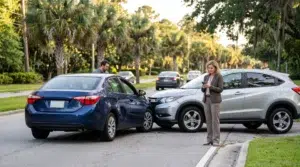
It depends on what happened. To ensure your rights are protected from day one, contact the Shelly Leeke Law Firm for a free consultation with a Charleston car accident lawyer. South Carolina law requires the driver of a vehicle involved in an accident that injures or kills anyone to notify law enforcement immediately, by the quickest means available (S.C. Code 56-5-1260).
Other crashes may not require a call to police, but if law enforcement does not investigate a crash involving $1,000 or more in total property damage, or any injury or death, the driver or owner must file their own report with the SCDMV within 15 days (S.C. Code 56-5-1270).
If you are asking, “Must I call police if I am involved in a South Carolina traffic accident?”, the safest practical answer is to call 911 whenever anyone may be hurt, the scene is dangerous, or you need help. Calling does not decide who is at fault, and not calling does not automatically end an injury claim.
When Must You Notify Police After a South Carolina Accident?
Under S.C. Code 56-5-1260, when an accident results in injury to or death of any person, the driver must immediately notify law enforcement by the quickest means of communication, oral or written. Ensuring this S.C. Code 56-5-1260 injury notification happens is critical. Which agency to notify depends on where the crash happened:
- Inside a city or town: the local police department.
- Elsewhere: the county sheriff’s office or the nearest South Carolina Highway Patrol office.
In practice, calling 911 reaches the right agency. The duty applies to any injury, not just serious ones. If you are unsure whether someone is hurt, treat it as an injury crash and call.
What If the Crash Only Causes Property Damage?
No statute requires a 911 call for every fender bender. If you need a Mount Pleasant accident reporting attorney to clarify your duties, know that whether law enforcement investigates matters, because 56 5 1270 then sets different paperwork duties:
- If an officer investigates, the officer prepares the collision report, which goes to the SCDMV.
- If no officer investigates and the crash caused total property damage of $1,000 or more, or any injury or death, the driver or owner must complete a Traffic Collision Report (Form FR 309) and send it to SCDMV Financial Responsibility within 15 days of the collision.
Damage adds up quickly with modern vehicles, so a crash that looks minor can easily reach $1,000. The SCDMV form warns that failing to file can lead to suspension of the owner registration or driving privileges. Filing an S.C. Code 56-5-1270 property damage report properly keeps your license active.
Should You Call Police Even If You Are Not Sure the Crash Is Serious?
Whether you were hit on a quiet street or need an Interstate 26 traffic accident lawyer Charleston, the answer is often yes. Reasons include:
- Injuries such as neck, back, or head injuries may not be obvious at first.
- Vehicles or debris in the road can create danger.
- The other driver may tell a different story later.
- The other driver may have no insurance, or may refuse to share information.
A law enforcement investigation creates a record made at the time of the crash. That record can be useful, but it is not a guarantee of any outcome. Insurance companies often exploit the South Carolina comparative negligence 51 percent rule to twist statements, making an official police record invaluable.
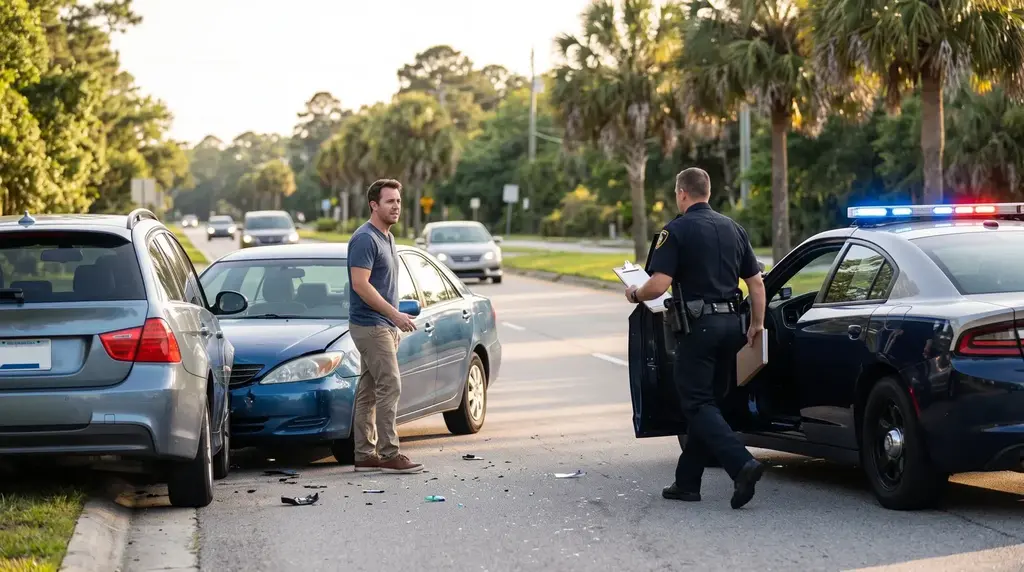
What Information Does a South Carolina Accident Report Contain?
A collision report prepared by the investigating officer generally records:
- The date, time, and location.
- The drivers, owners, and vehicles involved.
- Insurance information.
- Witnesses.
- Reported injuries and damage.
- A diagram and narrative.
- Any citations issued.
The report reflects the officer’s observations and the information gathered at the scene. It can be important evidence, but it does not decide civil liability. Insurers and courts, if a case is filed, can consider many other forms of evidence, and an officer’s opinion about fault is not necessarily the final word.
What Is an FR 10?
The FR 10 is South Carolina insurance verification form, often called the green form. When an officer investigates a crash, drivers are typically given an FR 10. Your insurance company completes it to confirm you had liability coverage at the time of the crash, and it is returned to the SCDMV. It is not the police report.
Under South Carolina financial responsibility law, failing to return a verified FR 10 within 15 days can be treated as evidence that the vehicle was uninsured and can lead to suspension of your license and registration. A North Charleston FR 10 lawyer can ensure your paperwork is processed on time. Give the form to your insurer promptly and confirm it was submitted, whether or not you were at fault. When no officer investigates, the FR 309 includes a similar insurance section.
What If Police Do Not Come to the Accident Scene?
Sometimes officers do not respond, especially to minor crashes or crashes on private property. If you reported an injury crash as required and no one investigated, or the crash met the property damage threshold, check whether you need to file an FR 309 within 15 days. Meanwhile, collect your own evidence:
- Photos and video of the vehicles, the scene, and your injuries.
- The other driver’s name, license, plate, and insurance information.
- Witnesses’ names and phone numbers.
- Dashcam footage and the locations of nearby cameras.
- Repair estimates.
- Your medical records.
How Do I Get a Copy of a South Carolina Collision Report?
You can request a copy from the SCDMV online, at a branch, or by mail using Form FR 50. The current form, revised January 2026, lists a fee of $10 per report. A copy is available only after the investigating agency report has been received and processed. You may also be able to get a copy from the investigating agency. Our FAQ on how to get a copy of your South Carolina traffic accident report has more.
Does Not Calling Police Prevent Me From Filing a Personal Injury Claim?
No, not automatically. A police report is not a legal requirement for bringing a personal injury claim. Claims can be built on photos, witnesses, medical records, vehicle damage, and other evidence.
Without a report, though, it can be harder to establish what happened, and a delay in medical care can make it harder to connect an injury to the crash. Report the crash as the law requires, document everything, and get medical care promptly.
What Should I Do After a South Carolina Traffic Accident?
Depending on the circumstances, a claim may include medical expenses, lost income, property damage, and pain and suffering. Keep in mind that under the S.C. Code 115-3-530statute of limitations, you generally only have three years to take action. Our South Carolina accident victims guidebook walks through more steps.
- Move to safety if you can do so safely. Do not leave the scene of an injury crash.
- Call 911 if anyone is hurt or you need help.
- Get medical care for any injury or new symptoms.
- Exchange names, license plate, and insurance information.
- Photograph the scene and vehicles when it is safe.
- Get witness contact information.
- Give any FR 10 to your insurer promptly, or file an FR 309 if one is required.
- Notify your insurer as your policy requires.
- Keep all medical bills, records, and receipts.
- Consider speaking with a South Carolina personal injury lawyer if you were hurt.
Talk to Shelly Leeke Law Firm About Your South Carolina Accident
If you were hurt in a crash anywhere in South Carolina, our South Carolina car accident attorneys can review what happened and what evidence exists. If litigation is required, your attorney will officially file the claim at the Ninth Judicial Circuit Charleston County Court of Common Pleas.
Request a free consultation with Shelly Leeke Law Firm or call (843) 604-3273. Let Shelly Leeke Law Firm Charleston evaluate your case at zero upfront cost, since our Charleston police report lawyer cost is purely contingency-based. No lawyer can guarantee an outcome.