

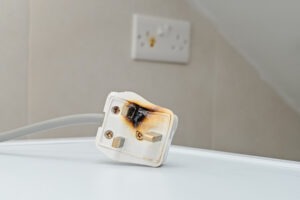
Product Injuries in North Charleston Homes
- Under S.C. Code § 15-73-10, a seller of a defective, unreasonably dangerous product can be liable even when it exercised all possible care in making and selling it.
- Keeping the item unrepaired and unreturned, along with its packaging and receipt, preserves the single most important piece of evidence in a product case.
- You do not need to have bought the product from the company you sue, because South Carolina’s statute removes the need for any contract with the seller.
- Many dangerous products are never recalled, so a missing NHTSA, CPSC or FDA recall does not end a claim that rests on proof of the defect itself.
- For claims arising after January 1, 2026, juries may assign fault to responsible nonparties, which makes identifying every seller in the chain more important than before.
A tire that shreds on I-26, a space heater that catches fire, a medication with risks the label never mentioned, a child’s toy that breaks into choking hazards: when a product injures you while you are using it in a normal way, South Carolina law puts responsibility on the companies that made and sold it. A North Charleston product liability lawyer at Shelly Leeke Law Firm can review how the injury happened and who in the chain of distribution should answer for it. Under strict liability, you do not have to prove that anyone was careless.
Before anything else, keep the product. Do not return it for a refund, repair it, or let anyone take it “for inspection,” because it is the most important piece of evidence you have. We have represented injured South Carolinians since 2007 from our headquarters at 6060 Rivers Ave, North Charleston, SC 29406. We work on a contingency fee basis, so you pay no attorney’s fees or case expenses unless we recover compensation for you. Our fee is calculated on the gross recovery before expenses are deducted. To have your product injury reviewed, schedule a free consultation.

Three Ways South Carolina Law Holds Product Companies Liable
A product injury claim usually rests on one or more of three legal theories. Each has different proof requirements, and many cases plead all three so that the claim does not depend on a single path to recovery.
1. Strict Liability
Under S.C. Code § 15-73-10, a seller engaged in the business of selling a product is liable for physical harm when the product was in a defective condition unreasonably dangerous to the user and reached the user without substantial change from the condition in which it was sold. The statute applies even though the seller exercised all possible care, and even though you did not buy the product from that seller or have any contract with it. The company’s quality-control budget does not matter if the unit that reached you was defective.
2. Negligence
A company that failed to use reasonable care in designing, building, testing, or warning about its product can be liable for the harm that follows. Negligence claims put the company’s conduct at the center of the case, and internal documents, testing records, complaint files, and marketing materials obtained in discovery can show what the company knew about a hazard and when it learned of it.
3. Breach of Warranty
Products carry warranties. Some are express promises made on the box, in the manual, or in advertising. Others are implied by law, including the implied warranty of merchantability under S.C. Code § 36-2-314, which requires goods sold by a merchant to be fit for the ordinary purposes for which such goods are used. A product that injures you while doing exactly what it was sold to do can breach that promise.
The Three Defect Types
South Carolina courts look at product defects in three main categories, and the category shapes the evidence and experts a case needs:
- Design defect: the product is dangerous as designed, even when built exactly to specifications. Examples include a top-heavy appliance that tips easily, a mower with an unguarded blade, or a battery pack that overheats because of how it was engineered.
- Manufacturing defect: the design was sound, but something went wrong in making your unit, such as a cracked weld, contaminated medication, or a missing component. These flaws are not unavoidable accidents; catching them is what quality control exists to do.
- Failure to warn: the product needed warnings or instructions it did not have, such as undisclosed drug interactions, a missing choking-hazard label, or absent safety instructions for a foreseeable risk.
The defective products we see most often include vehicles and vehicle parts such as airbags, tires, and batteries; prescription drugs and medical devices; children’s toys and nursery equipment, which our North Charleston child injury lawyer page also covers; household appliances and chargers; power tools; food products; and building materials. Asbestos-containing products raise their own issues, which our North Charleston asbestos exposure lawyer page explains.
Everyone in the Chain Can Be Liable
South Carolina’s strict liability statute reaches any seller engaged in the business of selling the product, not only the company whose name is on it. That can include the manufacturer, the maker of a defective component, distributors and wholesalers, and the retailer that sold the item. This matters in practice: when the manufacturer is overseas, dissolved, or bankrupt, a domestic distributor or retailer in the chain of distribution may still be here and still responsible. The statute does not cover a casual, one-time seller, such as a neighbor at a yard sale, because it applies to sellers in the business of selling that kind of product.
The 2025 tort reform law makes this step more important. Under Act No. 42 of 2025, for claims arising or accruing after January 1, 2026, a jury can, under conditions set out in the statute, assign a share of fault to a responsible party who is not a defendant, and a defendant whose fault is less than 50% of the total pays only its own percentage of the damages (§ 15-38-15). Identifying and naming every responsible seller early helps keep fault from landing on someone who never has to pay.
Recalls: Helpful, Not Required
A recall by the National Highway Traffic Safety Administration, the Consumer Product Safety Commission, or the Food and Drug Administration can be strong evidence that a defect was real. One familiar example is GM’s 2021 recall of 2020–2022 Chevrolet Bolt EV and 2022 Bolt EUV vehicles because the high-voltage battery could pose a fire risk when charged to full or nearly full capacity.
Even so, no product recall is required for your claim, and a recall you never heard about does not bar it. You can check vehicles, tires, and car seats through the NHTSA recall lookup and search consumer products and drugs on the CPSC and FDA websites; whether or not your product is listed, keep it.
The Defenses You Should Expect
Manufacturers and their insurers tend to raise the same few arguments, and knowing them in advance helps you protect your claim from the start:
- Misuse. The company may say you were not using the product as intended. The Restatement comments that § 15-73-30 adopts as South Carolina’s legislative intent look at normal handling and at uses the seller had reason to anticipate, not only the uses described in the manual.
- Alteration. The company may say someone modified the product after sale. Strict liability requires that the product reached you without substantial change in its condition, which is one more reason the product itself, unrepaired, is your strongest evidence.
- Knowing use of a discovered defect. Under § 15-73-20, a user who discovers the defect, is aware of the danger, and still unreasonably proceeds to use the product is barred from recovery under the strict liability chapter.
- Comparative fault. On negligence-based claims, South Carolina follows modified comparative negligence (Nelson v. Concrete Supply Co., 303 S.C. 243 (1991)). You can recover if your share of fault is 50% or less, and your award is reduced by your percentage.
Compensation You Can Pursue
A successful product claim seeks to cover the full effect of the injury on your life, including losses that will continue well after the case ends:
- Medical bills, including future and ongoing care
- Lost income and reduced earning capacity
- Property damage the product caused, including fire damage to a home or vehicle
- Pain, suffering, emotional distress, and loss of enjoyment of life
Punitive damages require clear and convincing evidence of willful, wanton, or reckless conduct, and a company that knew about a defect and sold the product anyway is the classic example. In most cases they are capped at the greater of three times compensatory damages or $500,000 (§§ 15-32-520, 15-32-530). Defective products often cause catastrophic injuries such as severe burns, amputations, and traumatic brain injuries. If a defective product caused a death, the family may bring a wrongful death claim through the estate’s personal representative (§§ 15-51-10, 15-51-20).
Product injuries also happen on the job, when a machine guard fails or a power tool malfunctions. Workers’ compensation generally covers the employee’s medical care and part of lost wages, but a separate claim against the manufacturer or seller of the defective equipment may also be available. Our North Charleston workers’ comp lawyer page explains the benefits side, and we review whether a product claim exists alongside it.
What to Do After a Defective Product Injury
The steps you take in the first days after a product injury protect both your health and your claim:
- Keep the product unrepaired, unreturned, and exactly as it was. Keep the packaging, manuals, and receipts too.
- Get medical care right away and tell your providers what happened, so the record ties the injury to the product.
- Photograph the product, the scene, and your injuries.
- Write down where and when you bought the item, and find the order confirmation or receipt.
- Do not give a statement to the manufacturer’s or insurer’s representatives, and do not accept a replacement or gift card in exchange for the product.
- Talk with a product liability attorney early, because expert analysis of the product takes time.
Deadline warning: most South Carolina product injury lawsuits must generally be filed within three years (§ 15-3-530(5)), with limited extensions for minors (§ 15-3-40). The product, witnesses, and purchase records can disappear much faster than that, and once the deadline passes, the claim is over regardless of how strong the evidence is.
Shelly M. Leeke: Reading a Product Case From Both Sides
Shelly M. Leeke is the firm’s managing partner. Before representing injured people, she defended insurance companies at Blue Williams in auto and workers’ compensation matters, which gave her an inside view of how defense teams evaluate and contest injury claims. That perspective is useful in product cases, where manufacturers and their insurers often argue misuse or alteration. She later moved to plaintiff work at Morris Bart and now leads the firm from its North Charleston headquarters.
Her training began at Wofford College, where she earned a B.S. in Psychology and a B.A. in Government in 1999, followed by a J.D., cum laude, from Tulane University Law School in 2002 and a clerkship at the Louisiana Supreme Court. Licensed in South Carolina and Louisiana, she wrote The South Carolina Accident Book, was named a Super Lawyers Rising Star, and received 2017 Forty Under 40 recognition. She is a member of the South Carolina Bar, the American Association for Justice, and the Charleston County Bar.
Areas We Serve
From our Rivers Avenue office, we represent people injured by defective products throughout the Charleston metro, including North Charleston, Charleston, Goose Creek, Moncks Corner, Summerville, Hanahan, Ladson, James Island, West Ashley, Daniel Island, and the rest of Charleston, Berkeley, and Dorchester counties. When a defective part contributes to a crash, our North Charleston car accident lawyer page covers the driver claims, and our North Charleston personal injury lawyer page covers other kinds of injuries.
Injured by a Product in North Charleston?
If a product failed in your home, your car, or your workplace anywhere in the Lowcountry, the item itself is the evidence that proves what went wrong. Call our North Charleston office at (843) 604-3273 before you return, repair, or discard it, so we can arrange to preserve it and begin identifying every seller responsible.
Product Liability FAQ
I threw the product away or returned it. Do I still have a case?
Possibly. Photos, the box, receipts, medical records, and other units of the same product can sometimes support a claim, but the case becomes much harder. If you can still retrieve the item from a store or anyone else, do it.
Do I have to prove the company was careless?
Not under strict liability. Under § 15-73-10, if the product was defective and unreasonably dangerous and reached you without substantial change, the seller can be liable even if it exercised all possible care in making and selling it.
The product was never recalled. Does that end my claim?
No. A recall is useful evidence, but it is not a requirement. Many defective products are never recalled at all, and a product liability case can stand on proof of the defect itself, supported by expert analysis.
I bought the product used. Can I still bring a claim?
Possibly. It depends on who sold it, whether they were in the business of selling that product, and whether it reached you without substantial change. Bring whatever you know about the product’s history, repairs, and prior owners.
The manufacturer is a foreign company. Is a claim still worth pursuing?
Often, yes. South Carolina’s strict liability statute reaches sellers engaged in the business of selling the product, so a domestic distributor or retailer in the chain may be responsible even when the overseas manufacturer is hard to reach.